10.9.11

Osh to Naryn Kyrgyzstan

Mikey and I are in Naryn, Central Kygyzstan. Tomorrow we will be headed to lake Song-Kol or lake Issi-Kol, we will decide sometime soon exactly what route we'll take.

It's been a great, but challenging ride to this point, I'll share a few anecdotes...

Out of Osh we travelled through the city of Ozgen before reaching Jalalabad. Ozgen has a noteworthy masoleum and minaret. At this location we met a 25 year old named Eugene. Eugene is among the 20 Russians still living in Ozgen, a city of 50,000. According to Eugene, at it's peak during Soviet times Ozgen was home to approximately 10,000 Russians according to Eugene. His family has lived in Ozgen for 4 generations. His great grandfather relocated to Kyrgyzstan during The Great Famon in Ukraine (1930s). The prospects of growing sunflowers (primarily for oil), having an income and feeding his family was the motivation behind his family's move.

Meeting Eugene and talking about these things raised a lot of thoughts and questions in my head: 1) Am I aware of one important decision my great grandparents had to make?, Answer: No. 2) Can I fathom my family living in a place for 4 generations and still considering myself an outsider, Answer: No. 3) Will there be a time when Eugene leaves Ozgen and never looks back? Answer: Yes, when his grandmother dies he will join the rest of his family in Russia. He and his grandmother are the family's lone residents in Kygyzstan...this leads me to realize that the Soviet legacy is slowly fading, but some things like a love for Vodka are still holding strong.

Out of Ozgen we traveled through Jalalabad and into the mountains. Beautiful and challenging we realized on our climb up the third 3000+ meter pass that we need a new map, as ours only had the first pass marked. I had a little bit of a break down on the steep, wash boarded/sandy switch backed road. I found solace in singing myself a Paul Simon song that goes like this "break downs come and break downs go, what are you going to do about it that's what I'd like to know..." I decided that I would push my bike up the mountain instead of riding it. After a  few hot hours we reached the peak and relaxed with some shepards. They invited us to stay the night.

We pitched our tent next to their yurts, ate more varieties of dairy products than I knew existed, road horses, and generally enjoyed the atmosphere. Although the most difficult day-physically and mentally, it has been the best so far. I have learned bike touring isn't easy, but it comes with big rewards. 

Tonight we'll eat Shashlik with some Peace Corps volunteers we just met. Things are coming together as they always do.

To reply to a few comments. Michael, I look forward to hanging out this winter and sharing more details with you, and also hearing about how life and the Philosophy Dept. at St. Mary's are doing.

Dennis, we'll be back in Missoula is January, I have a ticket booked forthe 15th although I may drive accross country with Mikey in the Black Pearl.

Dan, we miss you! 

Thank you all for your consistant support.

31.8.11

The Bike Trip Begins

I apologize for the long silence...the last few months in Tajiksitan were amazing!

Mikey did a lot of mountaineering...lots of stories to share when we see you next, but I'll give an overview to wet your palet.

2 friends from St. Mary's came to visit, they picked an epic route to hike, Mikey got high altitude pulminary adima resulting in the need to drop altitude as quickly as possible. Mikey's health improved, but they were in a restricted area, verbal permission was granted for their presence in this area, but internal communication wasn't good. They were escorted from the area by the FSB (KGB) and were under supervision for 3 days working out all the details.

A climbing group with the American Alpine Club came to visit the Pamirs. Mikey was invited to hike/climb with them and had a great time. On one trip they summited a previouslly unclimbed peak.

As for me, I participated in some amazing work being sponsored by the US State Department in rural and conservative areas of Tajikistan. Summer Camps, specifically CAMP AMERICA! American style summer camps complete with Art, English, Drama, Sports, Rock Climbing, and more. It was spectacular, and it is my plan to return to Tajikistan next summer to repeat the whole expereince, woo hoo!!!

We left Tajikistan 5 days ago on bicylces and are now in Osh, the second largest city in Kyrgyzstan. Our last day in Tajikistan we were treated to a spectacular day by a co-worker Maksud and his fmaily in the Isfara- Ferghana valley region. We will miss Tajikistan more than words can express!

Our first four days on bikes was great, my crotch and legs are a little sore, but I'm confident these aches will pass. In this part of Kyrgyzstan it is very hard to avoid Uzbekistan, which we don't have visas for, it's both inside and outside of Kyrgyzstan, and we zigged and zagged to avoid it, we'll continue to zig and zag around Uzbekistan in the next two days too.

Similar to Tajikistan, Kygryzstan has new roads being built by the Chinese. We road through a 100 plus kilometer Chinese construction sight. I was surprised to see a middle aged Chinese women in the middle of the Kygyz desert working to build a new road. When Mikey and I talked about her potential motivation, Mikey reminded me that there are more poor people in China than there are people in the U.S. People who find themselves struggling to survive are usually willing to take oppurtunities for change, even if that oppurtunity comes late in life and happens to be a desert in Kyrgyzstan. Made me think.

We discussed Chinese influence and business in Central Asia and the world, and talked about the potential for China to continue gaining influence and power and to once again perhaps "rule the world", Mikey was clear in adding "again" after this statement.

In the guest house this evening we have a small, ecclectic group of 8 people: Americans, Iranians, a Syrian-Swiss, Australians, and a Canadian. It has been informative to compare the versions of history that we have learned and use as our lenses to understand the world. They're different, and it's been fun to debate on the facts and theories (philisophical and conspiracy) of life.

On  to Jalabod tomorrow... our plans are to spend a month in Kygyzstan, 3 weeks in Kazakstan, then we will fly to New Delhi and head to Nepal. We fly from Mumbai to Baltimore on Dec.20th. I'll do my best to check in every now and then.

10.3.11

Dog Milk, Yum!

In Tajikistan it's common to have fresh milk available, many families have their own cow that they milk daily. It's a treat, especially when your lucky enough to be offered the fresh cream!

Sometimes our office cook, Venera, brings me a mug of fresh milk in the morning. So, when my co-worker asked me if I wanted some milk this weekend, of course I said I'd like a little.

Ali-jon: Would you like some fresh milk?

Me: Thank you, I'll have a little.

Ali-jon (in English- he  knows a few words and always tries to speak to me in English): I have small dogs.

My internal thoughts: His translation must be wrong, I'll clarify in Tajik

Me (in Tajik): Dogs, the milk is from a dog?

Ali-jon (in Tajik): Dog, yes. Only two puppies are alive, the others died. (He mimes milking) We have gotten a lot of milk, 5 liters.

This was a first for me. I reflected on why my internal response was not one of excitement. I drink cow milk, I drink goat milk, why wouldn't I drink dog milk? I drank a little and surprisingly it tasted just like milk, but maybe a little more like skim milk than whole milk.

9.3.11

Ladies...Yeah Ladies...

Yesterday was International Women’s Day, March 8th, иди занхо! This is a big holiday in Tajikistan with a lot of build up. During the past week it has been common practice for both friends and strangers alike to congratulate me on my womanhood. An email from my coworker Bobobek is a great example of the holiday’s sentiment: “Dear Ali, I congratulate you and your female families with international Women’s Day. I wish all the bests of the world, good health, and a long and happy life!” It is a day of rest for the whole country.

Madena, Makhlio, and Farzona are some of the women I spent the day with. 

Our lunch at work on Monday was a special treat. Osh, a favorite national dish was prepared and our male coworkers recited poetry to us about how wonderful women are as we ate. There was an awkward silence from the male contingent when I asked if they helped out with housework on women’s day. An older gentleman broke the silence by stating “well, that doesn’t happen in every house.” My female coworkers joked that it might not happen in any house. 

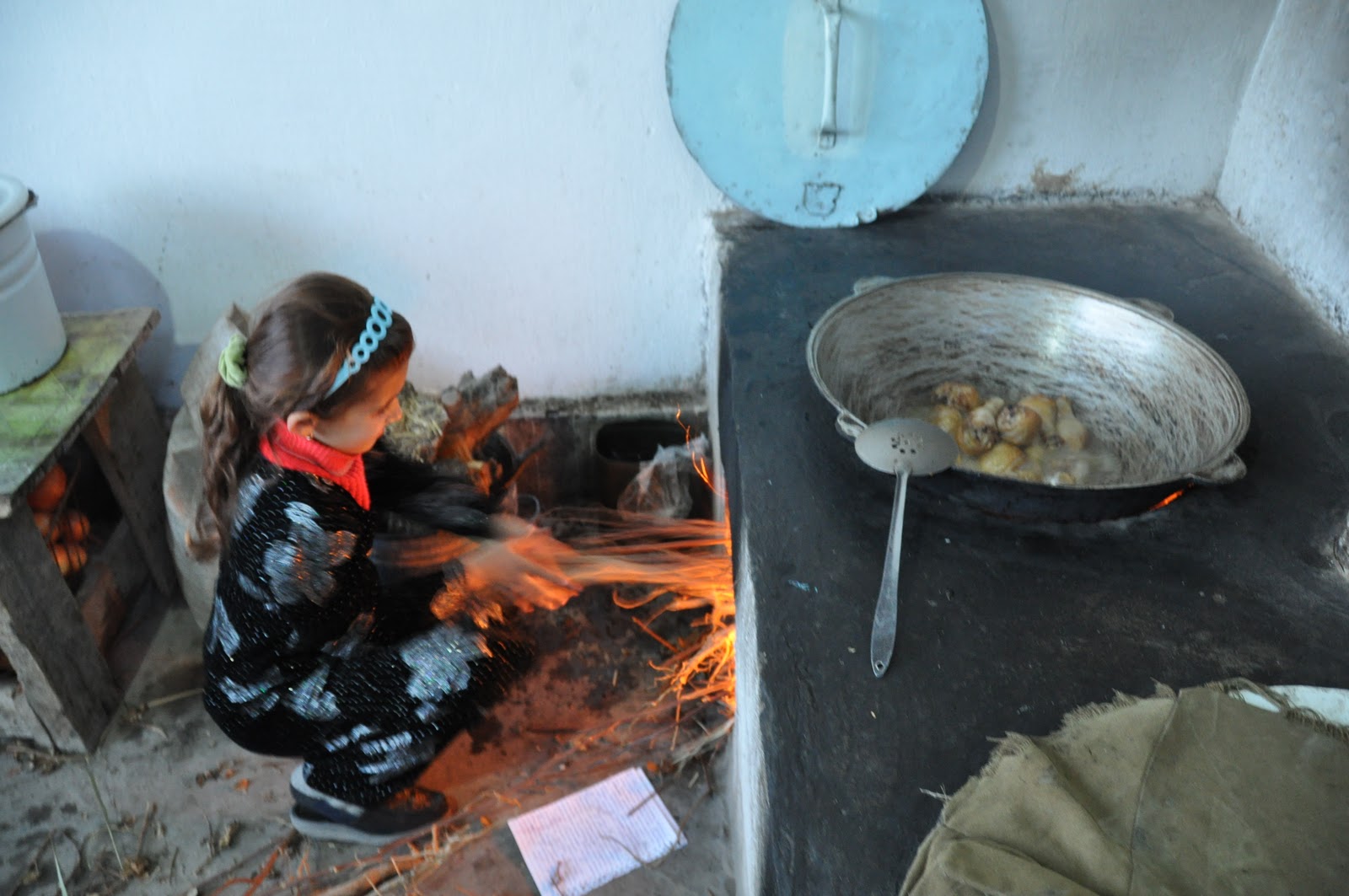
 Madena stokes the fire to cook dinner.

The novelty of this new holiday was a wonderful experience. I’ve never before felt so glorified for being born with two X chromosomes. I spent lunch in the company of my female friends, midday was a time reserved for females to spend together in celebration and appreciation of one another. Dinner was a family affair, with more food than we could consume, and lots of toasting to women and womanhood. 

 The dinner spread. There wasn't enough room on the table for all the food!

In a society where men dominate everything, except maybe childbirth, it was a special day and perhaps a needed one.

Cross Border Market in Ishkashim

Ishkashim is the gateway to the Wahkan Corridor in Tajikistan. From the Wahkan a person in Tajikistan can see both Afghanistan and Pakistan; it’s a place with overlapping geography and cultures. Other than its remote location, it’s an ideal place to have a market.

The Ishkashim Market is located on an island in the middle of the River Panj between Afghanistan and Tajikistan. To get to the market we left our passports at a folding table that the Tajik military manned and walked across a bridge to the island. From Khorog it costs 60 Somoni ($13) round trip to travel to this market. It’s a high price people are willing to pay because the goods are cheap and unique, and can be resold at higher prices. The market is a place where people come to do business, tourists are less common. We were novelties and attracted a lot of attention; we were both people watching and being watched.

Goods being sold included: rugs, clothing, opium, spices, soap, makeup, handmade and second hand shoes, juice boxes in bulk, cheap (really cheap) Chinese goods, fruit, baskets, and many other things that I’m either forgetting or aren’t worth listing. No market in Tajikistan has the same abundance of second hand western clothing, digging through piles familiar labels jumped out at me: Old Navy, Gap, Levi, and Patagonia. The second hand boots had soles that were worn past any I’ve ever seen before, it was clear many marathon distances had been walked on tough terrain by the previous owner(s).

The Afghans at the market had a few striking traits that distinguished them from their Tajik neighbors. Their skin was more weathered, their sense of style more conservative, and their eyes a variety of colors- piercing greens and blues among the most distinctive. Mikey found that many people were eager to have their photo taken, and a few of his wonderful pictures can be seen in the new slide show.

When we were ready to return to Khorog, we walked back across the bridge, retrieved our passports with ease, and looked for our driver. While we were enjoying the uniqueness of the market, our driver had driven into the Wahkan and loaded his Tengen (mini-van like vehicle) with soap from Pakistan. He returned to the market where large Kamaz trucks were waiting to be filled with his soap and other goods to take to other markets through out Tajikistan.

Over mountains, rivers, and borders, it was interesting to see some of the more extreme terrain goods pass over on their way to markets. It felt like I was witnessing a beginning stage of the entrepreneurial process, but in reality it was far along. We left the market with some cinnamon, pomegranates, a noodle maker (for Mino, see previous blog post Women in Barcheed 12/2010), and photos as souvenirs. It was a good day!

8.3.11

Tengen Tough

To tell this story I must first explain what a Tengen is, in the Pamirs it’s the most common form of public transportation. It’s kind of like a mini van, but looks more like a septic tank on wheels. A simple metal box with a go-cart sized engine that acts like the energizer bunny, it just keeps going and going. Well, until it doesn’t go anymore; we’ve been told one Tengen costs around $6,000 and can endure approximately 2 years of consistent work. The roads take a toll on cars and passengers.

The Tengen is rumored to be named after a character in a very popular Korean Soap Opera of the past. The character was abnormally small and was always working hard…just like all the motorized metal boxes in Badakhshan. If this story is true, the name is honoring the function the Tengen fills in a very harsh environment. Although it is easy to both love and hate the Tengen.

Mikey served as our tour guide in and around Khorog. He’s spent a lot of time in Tengens. He has a strategy: “Whether right or wrong, I always try to sit in the middle bench seat in the middle seat, if there is a wreck I think I’ll have the highest chance of survival if I’m sitting in this seat.”

On the day we traveled to the cross border market in Ishkashim, four of us were traveling and only one person could have this seat, and that was awarded to our guest Myles.  Katie, Mikey and I piled into the back seat and Myles sat in the safest spot in the Tengen, so we thought. As our Tengen was pulling out of Khorog another passenger was picked up. This resulted in 4 full grown men being squished in to the middle bench of the Tengen.

3 hours later we arrived at the market in Ishkashim. Initially, Katie, Mikey, and I were the only passengers able to walk with out a severe limp as we stumbled out of the Tengen. On this day Myles demonstrated his tolerance for uncomfortable situations, this is a good quality to have as a tourist in Tajikistan. To love and hate the Tengen is part of visiting Badakhshan.